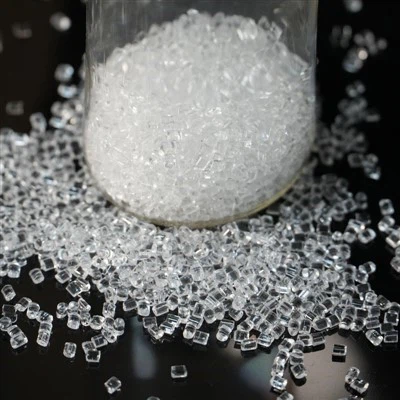
1. Density range and test standards of transparent nylon
The density of transparent nylon is usually between 1.12-1.16 g/cm³, and the specific value varies slightly depending on the brand and formula. For example:
- The density of Trogamid CX from Evonik in Germany is 1.12 g/cm³ (data from its technical data sheet);
- The density of UBE PA transparent nylon from Ube Industries in Japan is 1.15 g/cm³ (reference UL Prospector database).
Density testing is usually based on ISO 1183 (plastic density determination standard), using the immersion method or density gradient column method. The density of transparent nylon is lower than that of ordinary nylon (such as PA66 density of 1.14-1.17 g/cm³), because the ring structure or comonomer is introduced into its molecular chain, which reduces the crystallinity.
2. Key factors affecting the density of transparent nylon
1. Comonomer type:
Transparent nylon destroys crystallinity by adding monomers such as cyclohexanedimethanol, and the density may be reduced by 0.02-0.03 g/cm³.
2. Processing technology:
The fast cooling rate during injection molding will lead to a high proportion of amorphous areas, and the density is slightly lower than that of extruded products.
3. Effect of additives:
Plasticizers or UV inhibitors may increase the density, but the range is usually no more than 0.01 g/cm³.