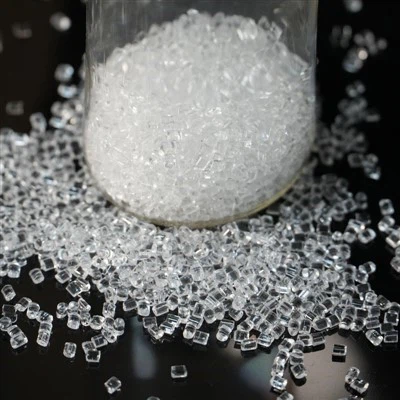
Transparent nylon can be modified by physical and chemical methods.
I. Chemical method
1) Introduce monomers containing side chains or ring structures in copolymerization, destroy the regularity of the molecular chain, reduce the hydrogen bond fraction and crystallinity, and obtain transparent amorphous products.
2) The straight-chain aliphatic monomers are subjected to multi-component random co-condensation to obtain a low-crystallinity or amorphous polymer.
II. Physical method
1) Add a nucleating agent to form microcrystals, reduce the crystal size to below the wavelength of visible light, and obtain transparent nylon containing small spherulites.
2) Quench the polymer from the molten state to below Tg as quickly as possible to prevent its crystallization, so that the randomly arranged polymer melt is frozen in an amorphous state.
The method of the main transparent nylon suppliers is to introduce monomers containing side groups or ring structures to destroy the regularity of the molecular chain and obtain amorphous or microcrystalline transparent nylon. Common types of transparent nylon include PA MACM12, PA 12/MACMI, PA 6I/X, etc.
Due to the large number of monomers with cyclic or side chain structures, the composition of almost every brand of transparent nylon is different. Here are two varieties for illustration.
(1) Nylon TMDT
Poly(trimethylhexanediamine terephthalamide), referred to as nylon TMDT (TMD is a mixture of 2,2,4 and 2,4,4-trimethylhexanediamine, T is terephthalic acid), its aromatic cyclic structure further prevents the molecular bonds between polymer chains, forming an amorphous polymer with high light transmittance.
Nylon TMDT is the first transparent nylon developed and industrialized by Dynamit Nobel in Germany. Its trade name is "Trogamid T". Its heat resistance, mechanical properties, mechanical strength and rigidity are comparable to PC and polysulfone. It was acquired by Evonik in 1988 and developed the TROGAMID T series of transparent nylon products.
(2) PACM12
In 1991, Evonik replaced the aromatic components in TROGAMID T with aliphatic monomers, achieving a semi-crystalline state of the polymer. Because the size of its crystals can only reach the nanometer level, it does not affect the transmission of visible light, so the material maintains high light transmittance and produces transparent polyamide with better UV resistance. The product name is: TROGAMID® CX, which is polymerized by n-dodecane dibasic acid and a cyclic aliphatic diamine called 4,4-diaminodicyclohexylmethane (PACM), and the English abbreviation is: PA PACM12.